

How Many Silverback Gorillas Are There in the World?
When travelers plan an ultra-luxury primate safari, the emotional focal point is almost always the silverback gorilla. Standing next to an alpha male a magnificent, 400-pound titan boasting a saddle of shimmering silver fur across his back is an experience of raw power and deep, ancestral connection. However, behind the awe-inspiring encounters lies a critical, high-stakes question that every conscientious conservationist eventually asks: How many silverback gorillas are there left in the world?
Out of a total global population of roughly 316,000 wild gorillas, there are an estimated 30,000 to 45,000 mature silverback gorillas in the world. This figure is directly tied to primate harem social dynamics, where only 10% to 15% of all wild gorillas mature into dominant, breeding alpha silverbacks. Critically, inside the highly endangered mountain gorilla populations, there are fewer than 150 to 180 active alpha silverbacks across the entire Bwindi and Virunga ecosystems, making them some of the rarest, most fiercely protected creatures on earth.
How Many Silverback Gorillas
Are There in the World?
The story behind the mountain gorilla numbers in Uganda, Rwanda and Congo and what it means to meet a silverback in the wild
You usually hear him before you see him. A branch cracks somewhere in the green, a deep rumble passes through the undergrowth, and the trackers ahead of you slow their pace. Then the leaves part, and there he is: broad-shouldered, unhurried, a saddle of silver-grey across his back, regarding you with calm brown eyes before returning to the stem of wild celery in his hands.
Meeting a silverback gorilla in the forests of Uganda or Rwanda is one of the most moving wildlife encounters on earth. And almost everyone who has one leaves with the same question: how many of these animals are left?
The answer is more interesting than a single number. It involves a crucial distinction between a silverback and a species, two small and precious forests, three countries, painstaking scientific fieldwork, and one of the most remarkable conservation recoveries of our time. This guide explains it all.

In Brief
A silverback is a mature male gorilla, not a separate species, so no one publishes a separate count of silverbacks alone.
The established estimate for mountain gorillas the gorillas you meet on a trek in Uganda or Rwanda is 1,063 individuals of all ages and sexes: about 604 in the Virunga Massif and 459 in the Bwindi Sarambwe ecosystem. A new Bwindi census began in 2025, with results expected in 2026.
Why There Is No Count of Silverbacks Alone
It is natural to assume "silverback gorilla" is a type of gorilla, in the way "mountain gorilla" is. It is not. The word describes a life stage. As a male gorilla reaches full maturity, the hair across his back and hips turns a distinctive silver-grey. That saddle of silver is the mark of an adult male, and it appears in every kind of gorilla.
Conservation scientists count gorillas by species and subspecies, and their surveys record animals of every age: infants clinging to their mothers, playful juveniles, adult females, young "blackback" males and fully grown silverbacks. So while census reports can describe the structure of a population, there is no regularly published global total of silverbacks on their own.
This matters because figures are often misquoted online. When you read that there are "just over a thousand silverbacks left", the writer almost always means the total number of mountain gorillas males, females and young together.
The World's Gorillas: Two Species, Four Subspecies
Gorillas are divided into two species, each found in a different part of Africa's equatorial forests.
The western gorilla lives in the lowland rainforests of Central and West Africa, in countries such as Gabon, Cameroon and the Republic of the Congo. It includes the western lowland gorilla by far the most numerous of all gorillas and the Cross River gorilla, a tiny and critically endangered population on the border of Nigeria and Cameroon.
The eastern gorilla lives further east, and it too has two subspecies. The eastern lowland gorilla, also called Grauer's gorilla, is found only in the eastern Democratic Republic of the Congo and is the largest of all gorillas. The other is the mountain gorilla, the subspecies at the heart of gorilla trekking in Uganda and Rwanda, and the one whose numbers this guide focuses on.
Silverbacks exist in all four. The difference is that mountain gorillas are counted unusually precisely, because their entire population lives in two small, intensively protected forest areas.
How Many Mountain Gorillas Are Left?
Every mountain gorilla on earth lives in one of just two places, both straddling the borders where Uganda, Rwanda and the Democratic Republic of the Congo meet.
The Virunga Massif: about 604 gorillas
The Virungas are a chain of volcanoes whose forested slopes are protected by three adjoining parks: Volcanoes National Park in Rwanda, Mgahinga Gorilla National Park in Uganda and Virunga National Park in the DRC. This is the landscape where Dian Fossey did her pioneering research. The most recent full census, carried out in 2015 and 2016, found 604 mountain gorillas here a significant rise on the 480 recorded five years earlier.
The Bwindi Sarambwe ecosystem: about 459 gorillas
Around 30 kilometres to the north lies Bwindi Impenetrable National Park in southwestern Uganda, an ancient, steep and densely forested landscape that continues across the border into the small Sarambwe Nature Reserve in the DRC. The 2018 census here estimated 459 mountain gorillas, up from about 400 in the previous count.
Add the two together and you arrive at the figure quoted by conservation organisations around the world: 1,063 mountain gorillas.
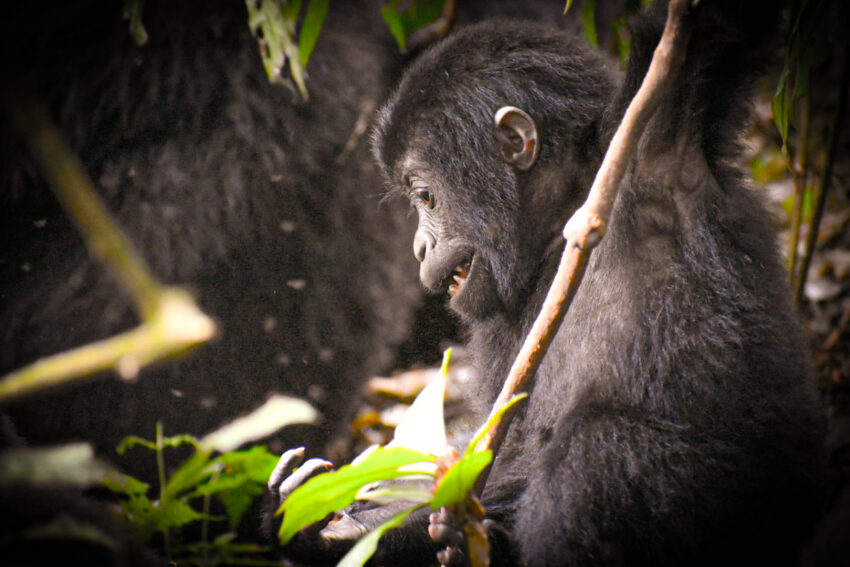

The 1,063 figure combines two surveys taken in different years. It is the best established estimate, but it should not be read as an exact headcount of the gorillas alive today. A new census of Bwindi–Sarambwe began in 2025, with results expected in 2026 the first in seven years, and the first to count the forest's chimpanzees too.
The newest census
The 2025 Bwindi Sarambwe census marks an important step for the region. Teams of rangers, trackers and scientists have walked carefully planned routes through the forest, recording nests and collecting samples for genetic analysis. For the first time, that genetic work is being carried out within the region rather than in laboratories abroad. When the results are officially released, they will give the most up-to-date picture of Bwindi's gorillas, and the global total will be revised accordingly. Until then, we recommend treating unofficial claims of new totals with caution.
Mountain Gorillas in Uganda, Rwanda and Congo
Because both gorilla populations cross international borders, there are no exact national totals — gorillas do not carry passports, and a family may forage in Uganda one week and in the DRC the next. It is more accurate to think about which forests each country protects.
Uganda
Uganda is home to the larger part of the world's mountain gorillas. Almost all of the Bwindi–Sarambwe population lives within Bwindi Impenetrable National Park, and Uganda also shares the Virunga population through Mgahinga Gorilla National Park, on the slopes of the volcanoes in the country's far southwest.
For travellers, this gives Uganda two very different trekking experiences. Bwindi is a world of steep ridges, tangled vines and mist-filled valleys, with trekking spread across four sectors around the forest. Mgahinga, by contrast, offers trekking on open volcanic slopes with views across three countries.
Rwanda
Rwanda's mountain gorillas live in Volcanoes National Park, part of the Virunga Massif. Its bamboo forests and volcanic slopes are among the most studied gorilla habitats on earth, thanks to decades of research at the Karisoke Research Center founded by Dian Fossey in 1967. Rwanda's gorillas are part of the shared Virunga population rather than a separate group, so they should never be added to the Virunga figure as an extra total.
The park lies a few hours' drive from Kigali, which makes Rwanda a natural choice for travellers who want to reach the gorillas quickly or combine trekking with a short stay in the capital.
Democratic Republic of the Congo
The DRC protects part of both populations: its Virunga National Park Africa's oldest national park, established in 1925 covers the western slopes of the Virunga volcanoes, while the Sarambwe Nature Reserve adjoins Bwindi. The DRC is also the only home of the eastern lowland, or Grauer's, gorilla, which is a different subspecies and is not part of the mountain gorilla count.
Visitor access to Virunga National Park depends on security conditions and park operations, which have changed many times in recent years. Anyone considering a visit should check current official travel advice and confirm the park is operating before making any plans.
What Makes a Silverback
A male gorilla is born weighing only around two kilograms. He spends his first years riding on his mother's back, then grows into a curious, playful juvenile. As he approaches adulthood he becomes a blackback physically strong but still dark across the back, and still finding his place within the group.
From around 12 years of age, though it varies between individuals, the hair on his back begins to turn silver. Over the following years he fills out into the formidable build of a full silverback: a broad chest, massive shoulders and arms, powerful jaws and a tall bony crest on top of the skull that anchors the chewing muscles needed for a diet of tough stems and leaves. A grown mountain gorilla male can weigh around twice as much as an adult female.
The role of the silverback in the family
Most mountain gorilla groups are led by a dominant silverback. He decides when the group moves and where it feeds, and he chooses where it will rest and build its nests each evening. When a threat appears a rival male, a predator, or anything he perceives as dangerous it is the silverback who stands between it and his family, often with a dramatic display of chest-beating, roaring and charging that is far more about intimidation than actual combat.
He is also, often, surprisingly gentle. Visitors are frequently struck by how patiently a silverback tolerates infants clambering over him, and by the way the youngsters cluster around him when he rests. His calm presence holds the group together, and disputes among females and juveniles are often settled simply by his attention.
Not every silverback leads
Mountain gorilla societies are more varied than the image of one male and his females suggests. Many groups contain more than one silverback often a dominant male and one or more younger silverbacks who may be his sons. Some males leave their birth group and live alone for a time before attracting females of their own. When a dominant silverback dies or is displaced, a group may be taken over by another male or may split apart. Leadership is shaped by relationships and temperament, not by size alone.


"The silverback's power is unmistakable. What surprises most visitors is his patience."
How Scientists Count Gorillas in a Rainforest
Counting animals that live in dense, mountainous forest, often in thick cloud, is extraordinarily difficult. Researchers cannot simply fly overhead and count, and many gorilla groups are not habituated to people, so they cannot be approached and observed directly.
Instead, census teams rely on the one thing every gorilla leaves behind each day: a nest. Every evening, each weaned gorilla builds a fresh nest of bent and folded vegetation to sleep in. Teams walk systematic routes across the whole forest, recording nest sites and the size of the dung found in each nest, which helps indicate the age of the gorilla that slept there. They also collect dung samples, from which the DNA of individual gorillas can be identified. Genetic analysis means every gorilla can be recognised as an individual and counted only once, even if its group is found more than once or crosses a border during the survey.
It is slow, physically demanding work. A census of Bwindi or the Virungas takes many months of fieldwork by large teams, and the genetic analysis that follows takes longer still which is why results are released years apart, and why every population figure should always be quoted with its survey date.
From Near-Extinction to Recovery
The mountain gorilla's story is one of the great conservation turnarounds. A census of the Virungas published in 1981 found just 242 gorillas, and many feared the subspecies would vanish before the end of the century. Today, the total across both populations is more than four times that number, and mountain gorillas are the only great ape known to be increasing in the wild.
That recovery is the result of decades of effort by many people. Rangers patrol the forests daily and remove snares set for other animals that can maim or kill gorillas. Veterinary teams treat sick and injured gorillas in the field. Researchers monitor the habituated groups every day. And communities around the parks, who share in tourism revenue and employment, have increasingly become partners in protecting the forest.
Why they are still endangered
Despite this success, mountain gorillas remain classified as Endangered on the IUCN Red List. Their total population is tiny and confined to two small forest islands surrounded by some of the most densely farmed land in Africa, leaving no room for the forests to expand. Because gorillas share much of our biology, they are vulnerable to human diseases, including respiratory infections, which is why visitor health rules are taken so seriously. Snares remain a constant threat, and political instability in parts of the region can disrupt conservation work. The recovery is real, but it depends on that work continuing.
Where to See a Silverback in the Wild
The only way to see a mountain gorilla silverback is to trek to him in his forest. The established destinations are Bwindi Impenetrable and Mgahinga Gorilla National Parks in Uganda, and Volcanoes National Park in Rwanda. In each, a limited number of gorilla families have been gradually habituated to the presence of people over several years, allowing small groups of visitors to spend time with them.
What a trekking day is like
The day begins early with a briefing at the park headquarters, where visitors are assigned to a gorilla family. Trackers will already have set out to locate the group from where it nested the night before. With a ranger guide, you then walk into the forest sometimes for under an hour, sometimes for several, depending on where the family has moved, the terrain and the weather. Paths can be steep, muddy and overgrown, and porters can be hired to carry bags and lend a steadying hand.
When you reach the gorillas, you leave walking sticks and bags behind and spend up to one hour with the family. You might find the silverback resting while infants tumble around him, feeding methodically on leaves and stems, or leading the group slowly through the undergrowth. Every encounter is different, because this is a wild animal living its own life not a performance arranged for visitors.

Uganda or Rwanda?
Both countries offer exceptional trekking, and the right choice depends on the shape of your journey. Uganda suits travellers who want to combine gorillas with chimpanzee tracking and classic savannah safaris, and who enjoy the wild, rugged character of Bwindi. Rwanda suits those who want to reach the gorillas quickly, perhaps on a shorter trip, with the added interest of Kigali and the country's other parks. Many travellers do both. Permit fees, availability and the rest of your itinerary all play a part, and permit prices can change, so it is always worth checking current rates before you book.
Trekking responsibly
The rules of gorilla trekking exist to protect the gorillas first. Visitors keep a set distance from the animals, stay together in small groups and follow their guide's instructions at all times. Anyone who is unwell must not trek, because a common cold can be dangerous to a gorilla. Never try to touch or feed a gorilla, and keep your voice low. The finest encounters are the quiet ones, where the family simply carries on around you.
Plan a Mountain Gorilla Trekking Safari With Savannah Explore Africa
Seeing a silverback gorilla in its natural habitat is an experience that stays with many travellers long after they leave the forest.
Whether you choose Bwindi Impenetrable National Park, Mgahinga Gorilla National Park or Rwanda's Volcanoes National Park, planning your trip involves more than securing a gorilla trekking permit. Accommodation, transfers, trekking logistics, fitness considerations and the wider itinerary all influence the experience.
Savannah Explore Africa specialises in tailor-made East African safaris, including mountain gorilla trekking in Uganda and Rwanda. We help travellers compare destinations, coordinate permits and accommodation, and combine gorilla trekking with other experiences such as chimpanzee tracking, wildlife safaris and cultural visits.
Meet a Silverback in His Forest
Whether you dream of Bwindi's misty ridges or the volcanic slopes of Rwanda, we design private gorilla journeys around your dates, your pace and your wider safari permits, lodges and trekking logistics handled with care.

Begin Your Journey
Your story starts
in East Africa.
Tell us your dates, your dream, and how you like to travel. We will design something extraordinary, only for you.